
Register
Sign in
Menu
Deconflict helps government organizations identify investigative overlap and coordinate across agencies and jurisdictions. Built for information sharing between authorized participants without replacing the investigative systems and workflows agencies already use.
Request Demo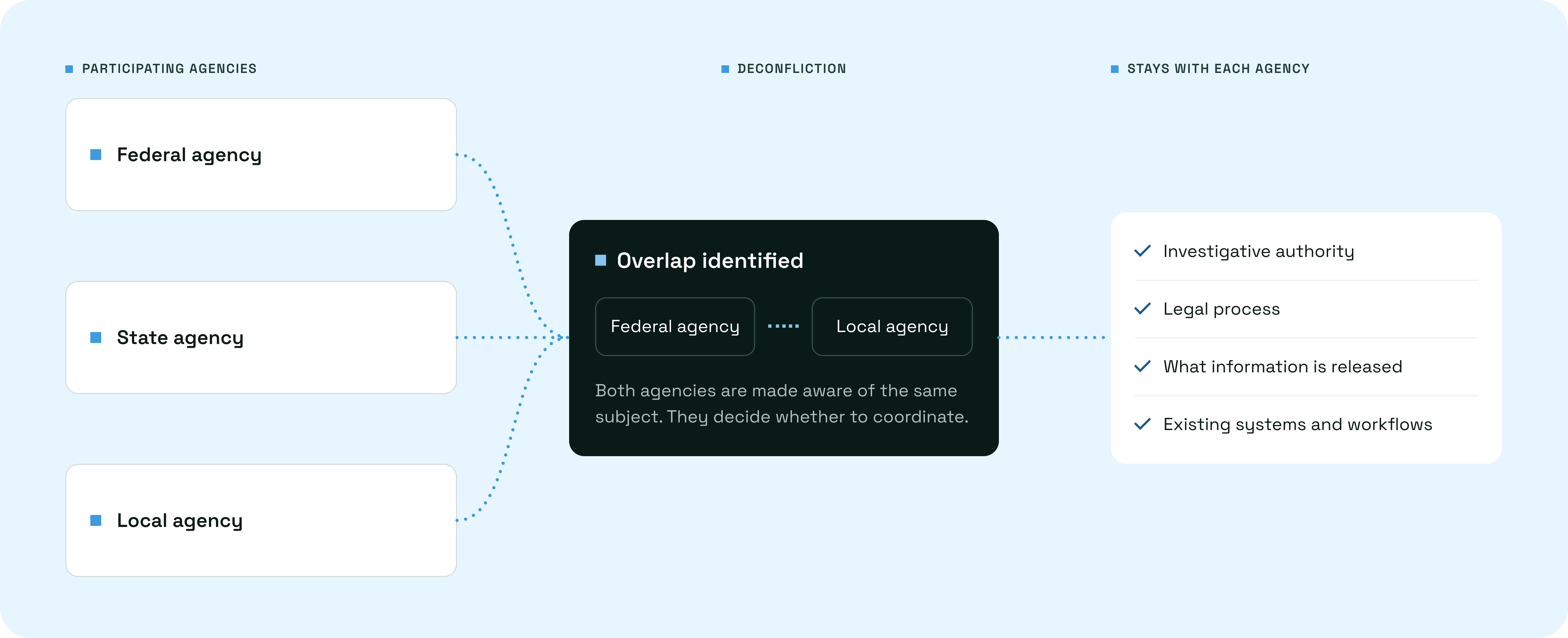
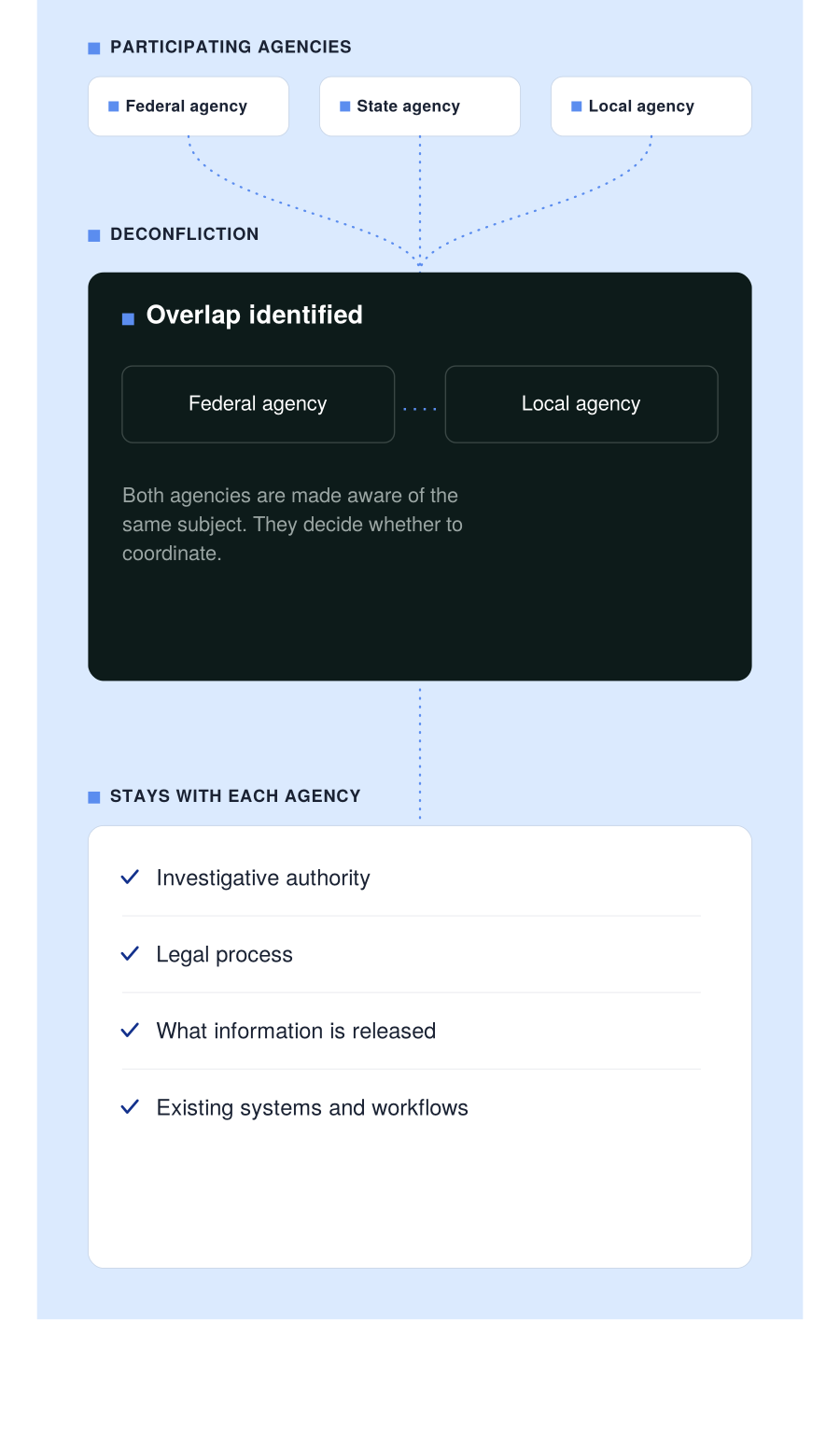





Two agencies may be investigating the same target without knowing it. A state or local investigator may possess information relevant to a federal investigation. Another agency may already have information connected to the same person, organization, account, asset, address, or digital identifier.
Deconfliction helps authorized participants identify that overlap, determine whether coordination is appropriate, and make those connections visible across participating organizations.
Participating organizations can determine whether relevant investigative activity exists elsewhere in the network.
Investigative authority, decisions, and legal process remain with the appropriate agency.

Federal, state, and local agencies operate under different authorities, policies, systems, and workflows.
The objective is not to consolidate investigations. It is to help authorized participants discover when their work intersects.
Investigative overlap is not limited to one type of crime or one mission area.
Each participating organization determines what information is appropriate to use within its authorized workflows.
Government agencies have invested in investigative platforms, records systems, intelligence systems, analytical tools, and specialized technology.
Agencies continue using the systems appropriate to their mission.
Government organizations have different operational, technical, security, and information-sharing requirements.
An evaluation begins with the mission and the problem the organization is trying to solve. Investigative authority, decisions, and legal process remain with the appropriate agency.
Request DemoGovernment organizations can structure an evaluation around a defined operational use case, participating organizations, information requirements, technical environment, and desired outcomes.
The purpose is to determine whether the platform improves the organization's ability to identify relevant investigative overlap and coordinate across organizational boundaries.