
Verified law-enforcement intelligence for compliance teams
Signal adds Verified Intelligence
from participating law-enforcement agencies to the compliance systems your analysts already use. It complements your monitoring stack, identifies the responsible agency or investigator, and opens a two-way channel for context or formal legal requests.
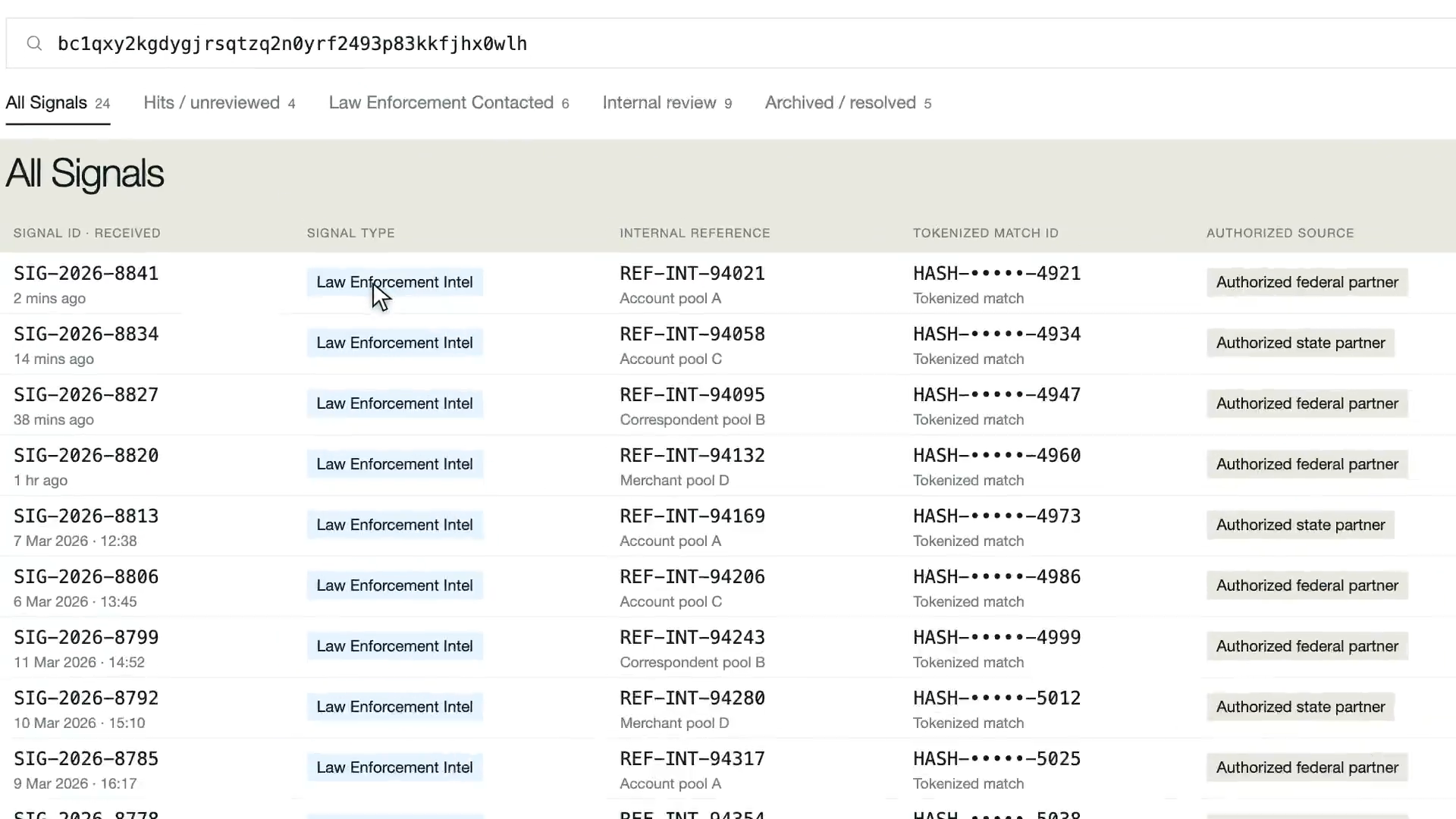
The Missing Question
Transaction monitoring and blockchain analytics help determine whether activity appears risky. They do not independently determine whether relevant law-enforcement intelligence is already available about a counterparty.
Your systems answer one question: Does this look like risk? Signal answers a different question: Is there law-enforcement intelligence relevant to this counterparty?
That distinction gives analysts more context at the point of decision.
Context at the Point of Decision
Identifies when relevant law-enforcement intelligence is available and delivers that information directly into transaction monitoring, blockchain analytics, fraud detection, sanctions screening, onboarding, and case-management workflows.
When an analyst reviews an alert, wallet, transaction, or counterparty, Signal surfaces relevant law-enforcement intelligence alongside the existing case data. The result is a more complete picture before any decision is made.
Intelligence That Informs Action
Analysts can evaluate Signal alongside existing risk signals when reviewing an alert, wallet, transaction, or counterparty.
Signal supports the analyst's decision. It adds Verified Intelligence from participating law-enforcement agencies alongside the risk signals your team already uses.
Enterprise-Ready, Stack-Agnostic
Supports API and existing-workflow deployment. Enterprise capabilities include enterprise authentication, secure cloud infrastructure, comprehensive audit logging, role-based access controls, and continuous platform monitoring.
Add Signal without replacing your current compliance stack.
Act Earlier. Spend Less Time Investigating.
Earlier visibility, centralized communication, structured request intake, and reuse of prior research can help reduce the time spent investigating and responding to subpoenas.
Direct access to investigator context can reduce manual chasing and duplicated research before a matter escalates.
Earlier law-enforcement context during onboarding, transaction monitoring, or continuous monitoring can help inform decisions that may prevent losses.
Regulators examine whether an institution has reasonable processes and controls in place. Signal supports documented engagement, audit trails, and consistent handling of law-enforcement intelligence.
Financial institutions and digital-asset companies depend on trust. Better controls can help reduce incidents that damage reputation, customer confidence, and enterprise value.
The cost of a compliance failure or enforcement action can vastly exceed the cost of the platform. Signal helps teams act with more complete information.
For Compliance Teams
We do not score, rank, or estimate likelihood. A match is corroborated or it is not surfaced.
IT & Procurement
API and existing-workflow deployment. Enterprise authentication, secure cloud infrastructure, comprehensive audit logging, role-based access controls, and continuous platform monitoring. Add Signal without replacing your current compliance stack.
The Intelligence Layer for Compliance Teams
That is how an alert becomes a better-informed decision and how analysts determine whether continued review is appropriate.
Request Demo