
Register
Sign in
Menu


Every financial institution spends millions of dollars building walls around its own perimeter. Compliance teams buy transaction monitoring software, deploy behavioral biometrics, screen payment instructions against sanctions lists, and hire investigators to review alerts. Yet across retail banking, corporate treasury, payment networks, and digital asset platforms, financial crime continues to grow faster than the tools built to stop it.
The reason is not a lack of detection technology. It is an architectural mismatch.
Modern criminal networks operate as fluid, interconnected enterprises that move across borders, payment rails, and institutions in minutes. Meanwhile, the organizations defending against them still investigate threats inside isolated silos. Until compliance and law enforcement teams bridge that coordination gap with timely, structured intelligence sharing, criminal syndicates will keep exploiting the space between institutions.
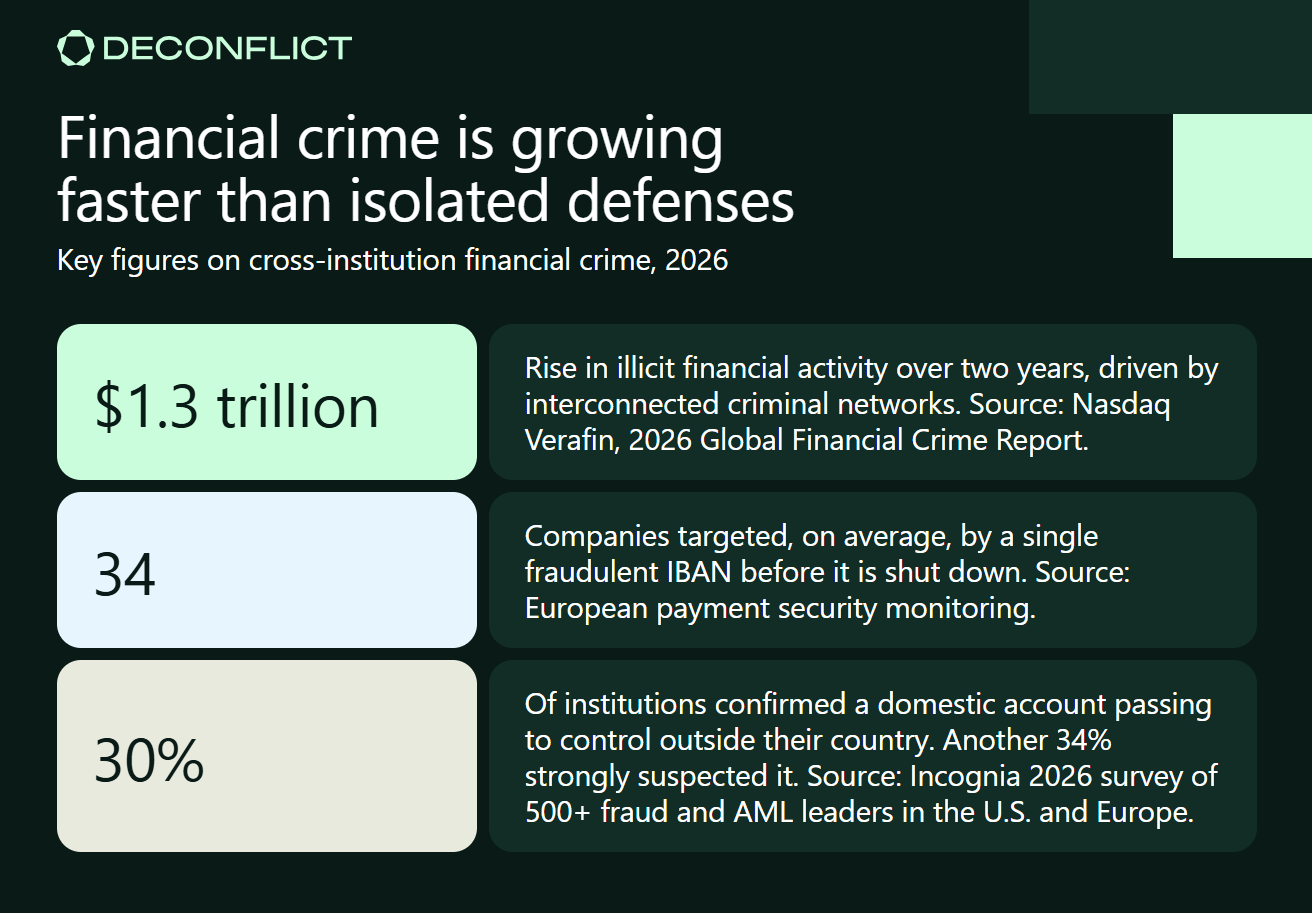
To understand why isolated controls fail, look at how financial crime actually operates today. In its 2026 Global Financial Crime Report, Nasdaq Verafin noted a $1.3 trillion surge in illicit financial activity over just two years, driven by deeply interconnected criminal networks. Fraud is no longer an opportunistic, one-off event carried out by a lone actor. It is an industrialized supply chain.
Consider three patterns reshaping risk across the global financial system:
1. Recycled Infrastructure at Scale Criminal syndicates rarely build fresh infrastructure for every target. Instead, they maximize the return on every compromised bank account, synthetic identity, or shell company they establish. Industry telemetry from European payment security monitoring shows that a single fraudulent International Bank Account Number (IBAN) is used to target an average of 34 different companies before being shut down. When an enterprise blocks a fraudulent vendor invoice or flags a suspicious payout rail internally, the syndicate simply pivots to the next corporate victim on its list. Without a mechanism to share that indicator across organizations, dozens of peers repeat the exact same vulnerability check from scratch.
2. Post-Onboarding Mule Account Handovers Traditional Know Your Customer (KYC) checks happen at a single point in time, when an account is opened. Criminal networks exploit that static checkpoint through organized mule networks and account handovers. A legitimate customer opens a verified bank or payment account, passes all identity checks, and then hands control over to an overseas syndicate. According to a 2026 survey of over 500 fraud and AML leaders across the U.S. and Europe by Incognia, 30% of institutions reported confirmed cases where control of a domestic account shifted outside their operating country, while another 34% strongly suspected cross-border handovers based on device and behavioral anomalies. Once funds enter a mule network, they are split and layered across multiple banks, fintech wallets, and cross-border rails before a single Suspicious Activity Report (SAR) is even drafted.
3. Convergent, Multi-Rail Attacks Criminals do not respect the organizational chart separating cybersecurity, card fraud, wire compliance, and digital asset risk. A single attack campaign frequently touches all of them at once. When attackers compromise a third-party website script or launch a credential-harvesting campaign, the same payload may skim payment card numbers at checkout, capture session cookies for corporate account takeover, and swap cryptocurrency deposit addresses in real time. One bank sees an unusual wire transfer; a card issuer sees a spike in compromised credentials; a crypto platform sees illicit inflows; a local police department takes a victim report. Each team holds one piece of the puzzle, and none of them can see the full picture.
When an organization relies strictly on internal telemetry, every investigation starts with an incomplete record. An analyst looking at a flagged wire transfer or an unusual account login can see what happened inside their own ledger, yet they remain blind to what happened ten minutes earlier at a peer institution.
In its 2026 white paper on cross-sector fraud information sharing, ACAMS identified fraud as the top anti-financial crime threat globally and highlighted a stark operational truth: effective disruption requires actionable intelligence to reach the exact parties positioned to intervene before victim funds leave the ecosystem.
When that intelligence stays trapped inside separate institutions, three predictable failures follow:
The solution is not turning compliance into an unrestricted data dump. Financial institutions and law enforcement agencies operate under strict privacy laws, bank secrecy rules, and investigative confidentiality requirements. Dumping raw customer records into a shared database creates massive legal, security, and operational risks.
Instead, global standard-setters and practitioners are converging on targeted, privacy-preserving signal matching.
In its 2026 global overview of public-private partnerships and data protection arrangements, the Financial Action Task Force (FATF) emphasized that effective information sharing depends on clear legal gateways, secure exchanges, and structured collaboration across banks, telecom operators, digital platforms, and law enforcement. Similarly, the UK’s National Economic Crime Centre (NECC) and multi-sector frameworks like Cifas have demonstrated that when institutions share specific, high-signal fraud indicators, such as confirmed mule account identifiers, scam phone numbers, and malicious domains, participants can block illicit transfers in real time without exposing unrelated customer data.
Research into established Financial Information Sharing Partnerships (FISPs) shows the tangible impact of structured public-private coordination. Over a multi-year period, targeted intelligence exchange through JMLIT alone helped identify more than 10,700 accounts previously unknown to law enforcement and led to the closure of over 8,100 illicit accounts. In Australia, co-located public and private analysts working in near real time have repeatedly disrupted active fraud rings and protected victims before life savings were irreversibly wired offshore.

Financial criminals succeed because they collaborate effortlessly. They buy stolen credentials from one marketplace, rent mule accounts from another, launder proceeds across multiple jurisdictions, and share successful scripts across encrypted channels.
Defenders cannot beat a networked adversary with isolated workflows. Whether a transaction moves across traditional banking rails, instant payment networks, fintech apps, or digital asset platforms, the underlying principle remains the same: visibility without coordination is just a better view of the loss.
When financial institutions, payment providers, and law enforcement agencies can verify whether an indicator is already tied to an active threat, safely, privately and in time to act, the economics of financial crime begin to shift. Instead of chasing yesterday's transactions across disconnected silos, teams gain the context they need to intervene while the window to stop harm is still open.
Deconfliction helps authorized participants check whether an identifier or activity may overlap with information held by another organization. Depending on the platform and its permissions, that can help teams find a relevant point of contact and coordinate next steps without making every case detail broadly visible.
It serves a different purpose from transaction monitoring or investigative analytics. Those tools can surface activity, trace funds or identify patterns. Deconfliction helps answer a further question: does another authorized participant have relevant context, and is there a controlled way to coordinate?
That connection can reduce duplicated effort and help investigators or financial institutions assess whether additional context is available. A match is not proof of wrongdoing, and it does not determine what action an organization should take. Each participant remains responsible for its legal obligations, its own assessment and any decision to act.
See how Deconflict helps authorized teams identify investigative overlap and coordinate through controlled channels. Learn more about Deconflict
What is financial crime deconfliction?
Deconfliction is a process for identifying whether an activity, identifier or case may overlap with information held by another authorized participant, then enabling appropriate coordination.
How is deconfliction different from transaction monitoring?
Transaction monitoring helps identify activity that may warrant review. Deconfliction helps determine whether another authorized organization may have relevant investigative context.
Does an intelligence match prove that someone committed a crime?
No. A match is a lead or signal to assess. Recipients should consider its source, status and context before making decisions.
Can organizations share intelligence without sharing full case files?
Information-sharing models can be designed around limited disclosures, access controls and defined purposes. The right approach depends on applicable law, agreements and operational needs.
Why does timing matter in financial crime investigations?
Funds and indicators can move across accounts and organizations quickly. Relevant context delivered earlier may help a team assess the risk while intervention options are still available.