
Register
Sign in
Menu

On October 29, 2026, an attacker moved approximately $6.36 billion from Binance wallets across ten blockchains. Most of the outflows happened in about 20 minutes. The FBI attributed the theft to North Korean actors it calls TraderTraitor.
The public blockchain record shows how the attacker prepared in the background. Funding an operator wallet, deploying contracts, testing delegations and rehearsing a sweep. Those actions did not prove who was behind the wallets or what they intended. Taken together, however, they formed a pattern that a behavioral risk check could have surfaced before the Binance wallet was delegated.
Deconflict replayed the public data through its ‘Behavioral Risk Signals’ proof of concept, stopping the clock at 20:20 UTC, just before the Binance wallet was delegated to the attacker’s contract. The replay triggered ‘BLOCK’, based on two origin signals, two preparation signals and a cluster check.
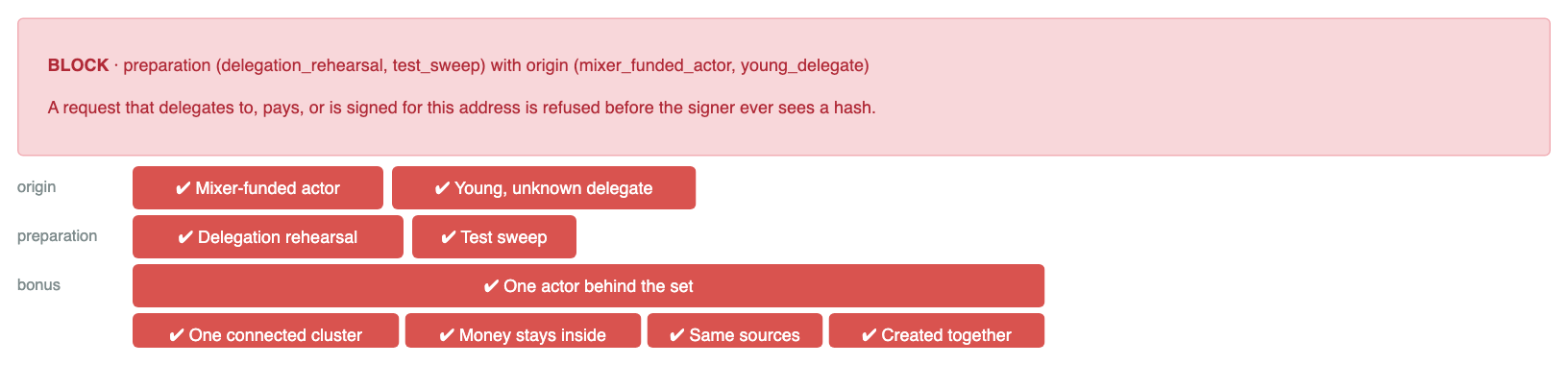
This was a retrospective replay, not a live detection. The system was not connected to Binance’s signing path and did not stop the theft. It does show what investigators and wallet operators can learn from the sequence: known bad addresses are not the only useful signals. Sometimes the behavior around a wallet matters more than its name. Moreover, a brand-new wallet or contract created by an attacker is not recorded in any BLOCKLIST, which is why looking at behavior matters most.
Deconflict’s replay shows the first sign of activity on October 28 at 07:39 UTC. The operator wallet received 0.098 ETH from a Tornado Cash pool. Other wallets later involved in the activity received funds from the same pools.
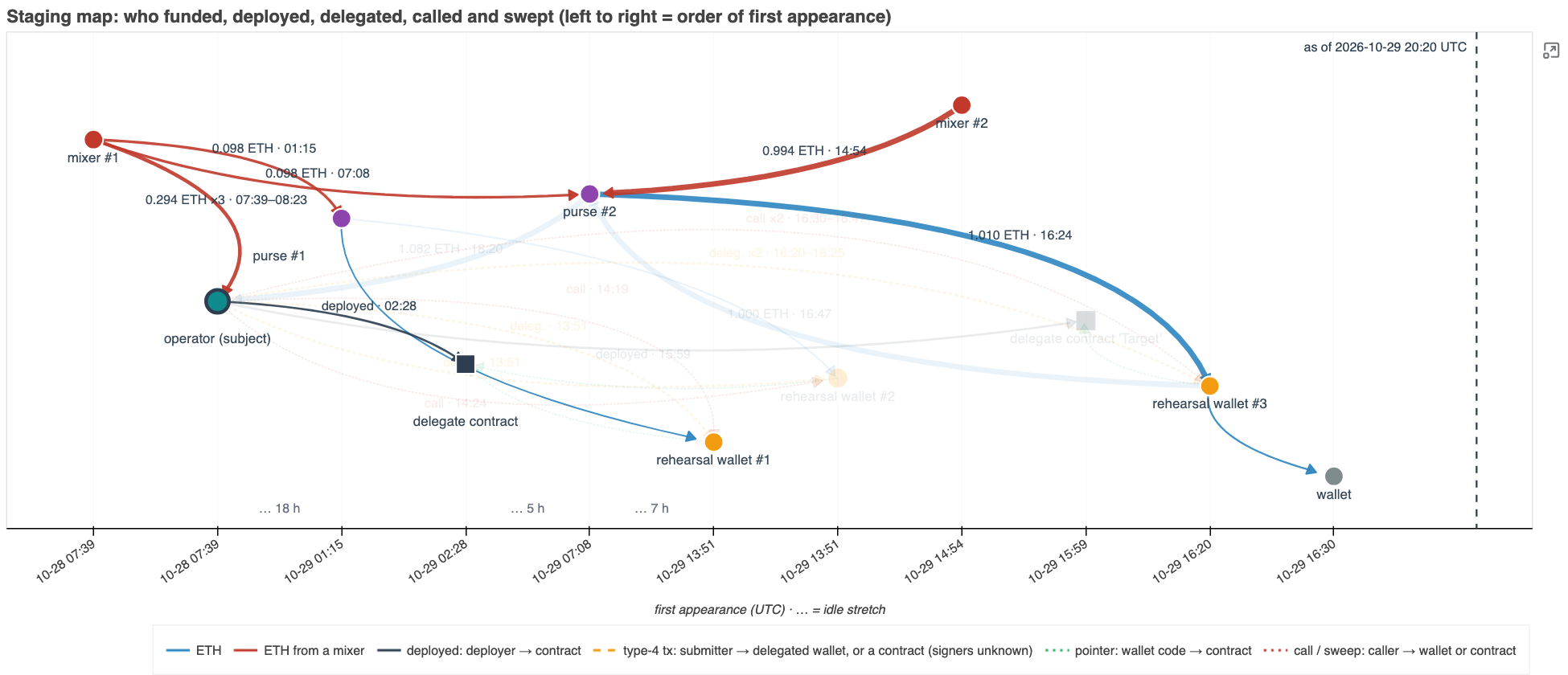
The next day, the operator deployed two contracts. It tested the first with new wallets starting about 11 hours later. Between 13:51 and 16:20 UTC, three wallets with little or no history were delegated to the operator’s contracts. (Delegation let the contracts act on those wallets’ behalf.)
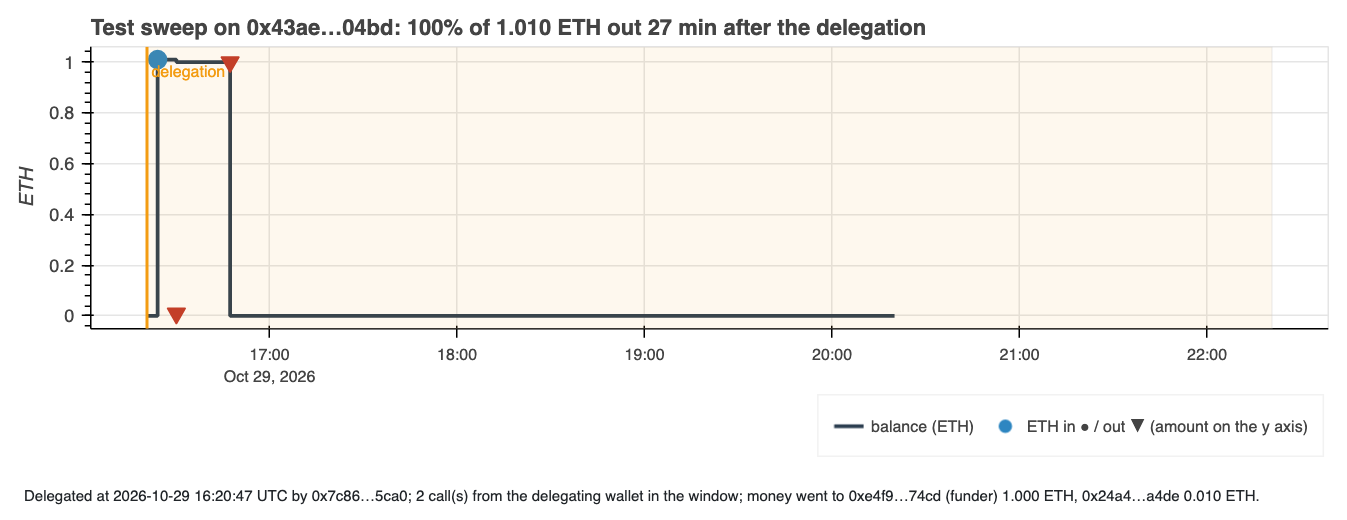
One test wallet received 1.01 ETH, was delegated to a contract, then emptied 27 minutes later. The operator made two calls to move the funds, sending 1 ETH back to the original funder. The operator deployed the second contract at 15:59 UTC, and it was used 24 minutes later. This was the contract later linked to the Binance wallet.
Reports show that preparation began at least 36 hours before the theft. The attacker tested code on two wallets, rehearsed the final version on a third, then used the same code against a Binance hot wallet four hours later.
Deconflict’s replay grouped six wallets and two contracts into one cluster. The oldest member of the set was only 37 hours old. Nearly all of the cluster’s 7.69 ETH moved among its members and Deconflict’s analysis traced the funds to two mixer pools.
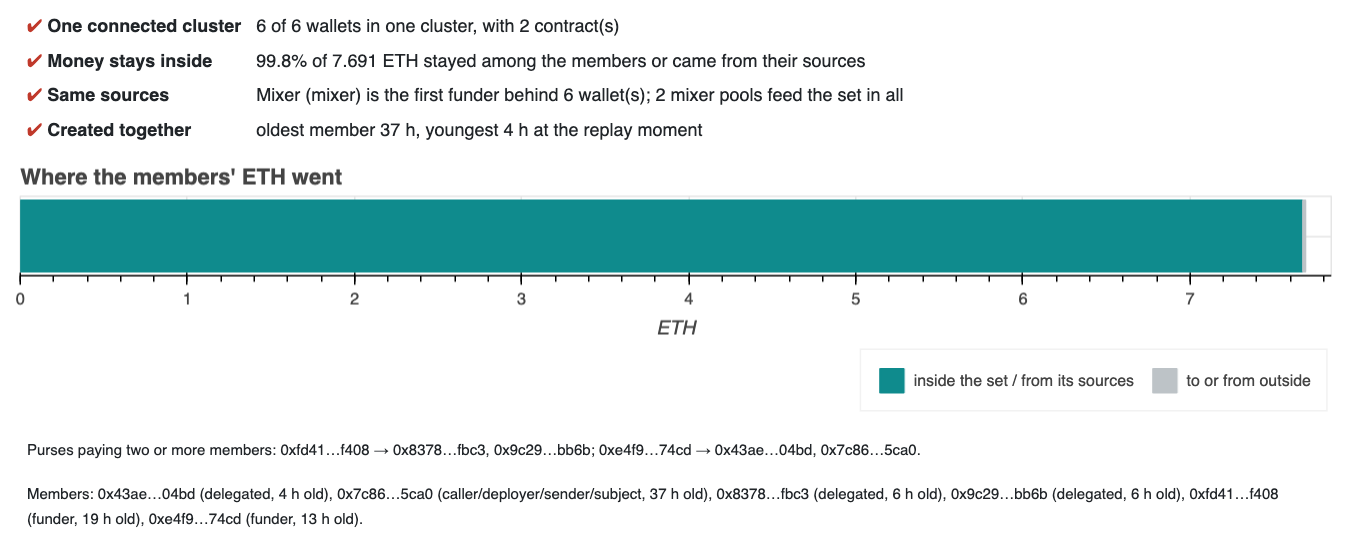
Those connections helped distinguish a sequence of related actions from a handful of unrelated events. The mixer activity was an origin signal. The new contracts and test wallets were preparation signals. The movement within the cluster added context.
The technical mechanism on Ethereum made that context especially relevant. EIP-7702 lets an externally owned account authorize a smart contract to execute code on its behalf. In this incident, the attacker submitted a transaction containing 50 pre-signed authorizations. One took effect, allowing the Binance hot wallet to run the attacker’s sweeper contract.
Behavioral analysis can only affect an outcome if it runs before the action it is meant to govern.
Binance said the attacker gained access to its internal wallet signing service and bypassed normal withdrawal procedures. Its report also said that suspending withdrawals did not revoke EIP-7702 authorizations that were already on-chain.
That hints towards a control placement problem. A check attached only to a standard withdrawal workflow may be irrelevant if a separate service, container or credential can send requests directly to the signer. Every route that can request a signature needs to pass through the same policy enforcement point.
For wallet operators, that means mapping all signing paths, including internal tools and deployment credentials. A request should be assessed before it reaches the signer, with the context needed to evaluate its origin, destination, permissions, related wallets and recent behavior. High-risk activity can then trigger a block, a hold or a second review, depending on the institution’s policy.
The signer should accept requests only through the approved control path. Otherwise, even a strong detection rule can be bypassed.
The on-chain sequence offers a practical checklist for incident response and prevention:
The assets stolen from Binance crossed ten networks. Token issuers and Arbitrum’s Security Council froze or intercepted about $2.7 billion during the response. The FBI urged virtual asset businesses and other private-sector partners to block transactions linked to addresses associated with the laundering activity. These actions show the value of fast, specific information sharing once funds start moving.
The earlier preparation raises a different question: how much context can a control assemble before the first signature? Deconflict’s replay suggests that public behavior may provide useful warning signals before an address appears on a sanctions list, attribution database or blocklist.
The Binance incident also showed that on-chain activity can reveal a clear pattern before funds move. Detecting that pattern is only part of the defense. Every authorization needs to pass a security check before it reaches the signer, so the check must be built into the system’s design.
Talk with Deconflict about what the Behavioral Risk Signals proof of concept revealed and how behavioral checks can fit into a wallet approval path. Connect with our team.
What happened in the Binance hack?
On October 29, 2026, an attacker moved approximately $6.36 billion from Binance wallets across ten blockchains. Most of the outflows happened in about 20 minutes.
What did Deconflict’s replay flag?
It combined signals related to wallet funding, newly deployed contracts, test activity, and connections among the wallets. Just before the Binance wallet’s delegation, the replay returned a BLOCK decision.
Why monitor EIP-7702 delegations?
EIP-7702 lets an externally owned account authorize a smart contract to execute code on its behalf. An unexpected delegation involving a treasury or hot wallet may warrant immediate review.
Do connections between wallets prove common ownership or criminal intent?
No. Shared funding or transaction patterns can help investigators identify leads, but they do not prove who controls a wallet or what that person intended. Each connection needs to be assessed alongside other evidence.