Register
Sign in
Menu
Crypto wallet sanctions screening checks a blockchain address against digital asset identifiers published in official sanctions data. Authorities may include wallet addresses in a designation to identify digital currency associated with a sanctioned person or entity. OFAC, for example, allows searches for digital currency addresses and returns exact matches rather than fuzzy matches.
For investigators, this can be an important early check. A wallet address may appear in a victim report, a transaction record, an exchange alert or an investigative lead. Screening helps answer a focused question: Does this exact address appear in the sanctions data we checked?
That is a narrower question than whether a person, business or transaction is subject to sanctions. The result should be read as a point-in-time data match, then assessed alongside the case facts and applicable requirements.
Digital asset transactions can move across borders and touch services in different jurisdictions. Checking a single country’s list may miss a designation published by another authority. A consolidated screening step helps investigators identify whether the address appears in the lists their workflow covers without searching each source separately.
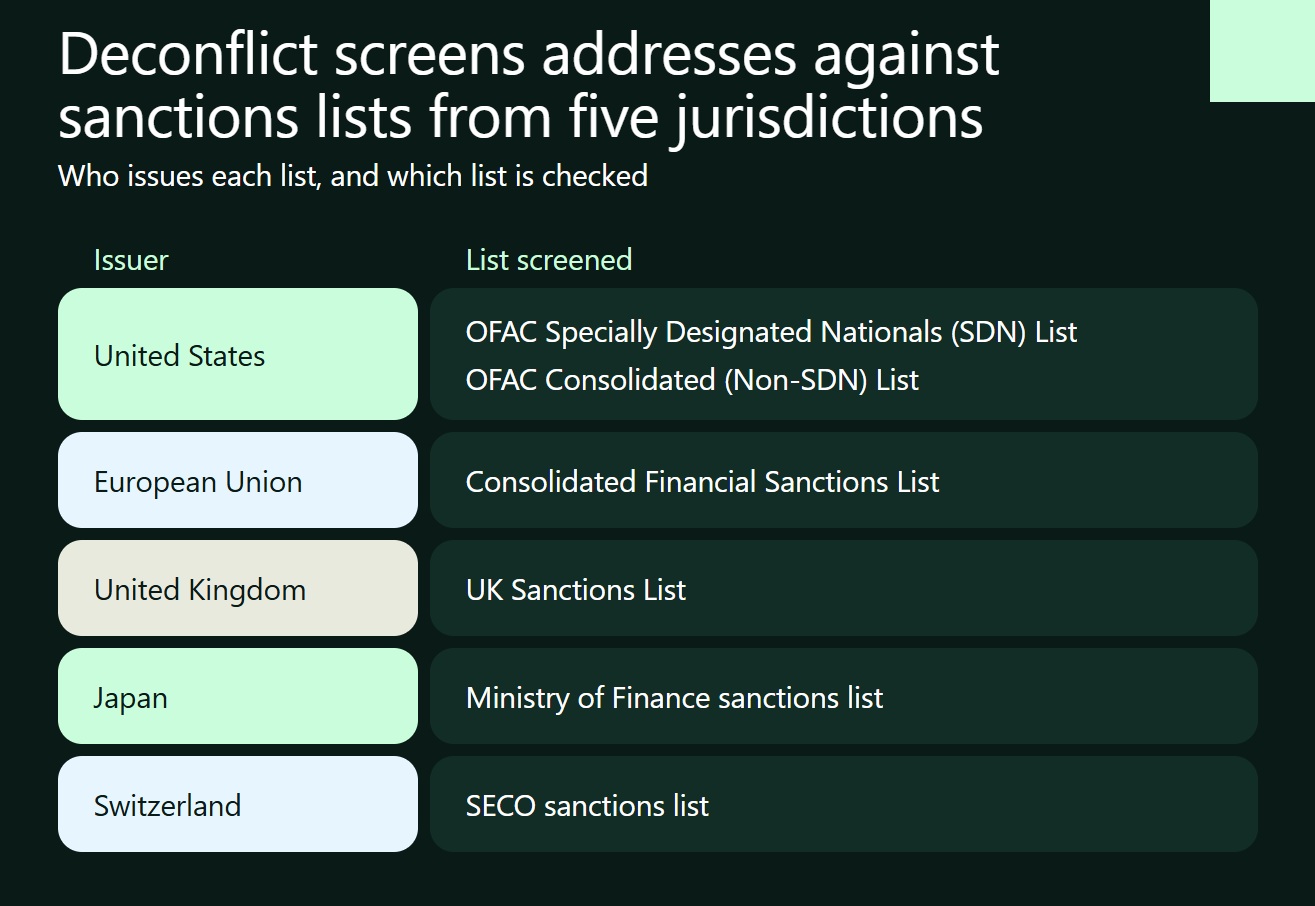
The names and legal effects of these lists differ. The European Commission’s consolidated list reflects financial sanctions adopted in official EU legal acts. The UK now maintains a single UK Sanctions List, which replaced earlier list arrangements in January 2026. Switzerland’s SECO database provides records of directly sanctioned people and organizations; SECO notes that its search tool does not provide ownership or control information.
This coverage is useful for an initial check, but “global” does not mean every country’s sanctions requirements are identical or that a single match determines the legal outcome everywhere. The relevant jurisdiction, sanctions program and transaction context still matter.
A flagged result means the wallet address exactly matches an address in one of the lists screened. Deconflict’s result identifies the issuing authority and list, so an investigator can trace the match to its source and record that information in a report or follow-up request.
A result that says only “high risk” leaves the investigator to ask where the signal came from, which list was checked and whether the underlying record is current. Naming the source makes the result easier to verify, document and communicate.
A match is still a lead, not a complete case conclusion. It does not by itself establish who controls the address, whether a specific transaction is prohibited or whether an institution must take a particular action. Investigators should preserve the result and examine it with relevant transaction data, case context and the procedures that apply to their agency or institution.
Deconflict returns one of three outcomes:
These labels have different operational meanings. “Clear” is bounded by the lists and data available at the time of the search. It is not a general assurance that the address has no connection to a sanctioned party or other illicit activity. “Unavailable” is a reason to retry or consult the official source, not a negative screening result.
For a case file, record the address exactly as checked, the date and time, the returned status and the list source. If a result is unavailable, record that outcome and follow the applicable escalation process.
A screening tool is only useful if investigators can trust how it handles updates and errors. Deconflict updates its sanctions data daily and is designed to fail safely when it cannot confirm that the data is current.
If an official source publishes an empty or damaged file, Deconflict retains the last valid copy rather than replacing good data with a broken update. The system also monitors update completion and alerts the team when a daily refresh fails. When a designation is removed, the address stops being flagged after the next successful update.
Address matching is exact. This avoids flagging a different address simply because it looks similar, while preserving the need for investigators to verify that the address they entered is correct. OFAC’s own address search also uses exact matching.
Wallet screening works best as one step in a documented investigative workflow:
This sequence keeps the screening result useful without treating it as a standalone attribution or legal decision. A list match can help prioritize an inquiry, but the investigator still needs to establish how the address relates to the people, transactions, and events under review.
For financial institutions and digital asset businesses, a single check across multiple official lists can simplify an early screening step. Source attribution helps teams explain why an address was flagged, while a clear unavailable status prevents an outdated dataset from being mistaken for a clean result.
Screening should fit into a broader control process. Teams should define what happens after each result, how they document decisions, and when they consult compliance, legal, or law enforcement. A clear result can close one specific screening question; it should not replace other due diligence or transaction review.
Global sanctions screening is now available to all Deconflict customers, with no setup required. Each wallet address check is screened against all five jurisdictions’ lists automatically. For investigators and financial institutions, the goal is straightforward: get a traceable answer quickly, understand its limits, and use it to guide the next step.
Which sanctions lists does Deconflict screen crypto wallets against?
Deconflict screens against lists from the United States, European Union, United Kingdom, Japan, and Switzerland, including OFAC’s SDN and Consolidated Non-SDN lists.
Does a flagged wallet prove that its owner is sanctioned?
No. It means the exact address appears on a screened list. Investigators should verify the source and assess the result in context.
Does a clear result mean a wallet is safe?
No. It means the address did not appear on the lists checked at that time. It does not rule out other risk, indirect connections, or later list changes.
What happens when sanctions data may be out of date?
Deconflict returns an unavailable result instead of treating the address as clear. The check can be repeated once the data is confirmed.
How often are sanctions lists updated in Deconflict?
Deconflict updates its sanctions data daily and monitors whether the refresh completes successfully.