
Register
Sign in
Menu

Crypto deconfliction is the process of identifying when multiple organizations may be investigating or reviewing the same cryptocurrency wallet or related identifier, then creating a controlled way to coordinate if appropriate.
The need is practical. A wallet can appear in an agency’s investigation, an exchange’s transaction review and a fraud inquiry at the same time. Each organization may hold a different piece of the picture, while privacy rules, investigative sensitivity and separate systems make it difficult to know who else is involved.
Deconfliction helps surface potential overlap early. It gives authorized participants a way to verify the connection and decide whether they should coordinate, without making investigative files or customer information broadly visible. In Deconflict’s model, the initial match reveals that another verified participant has the same identifier. It does not automatically expose the other organization’s case or customer.
Digital asset investigations often cross organizational and jurisdictional boundaries. Funds may move between self-hosted wallets, exchanges, payment providers and other services. Law enforcement may be investigating a theft while an exchange reviews a deposit and a financial institution examines related customer activity.
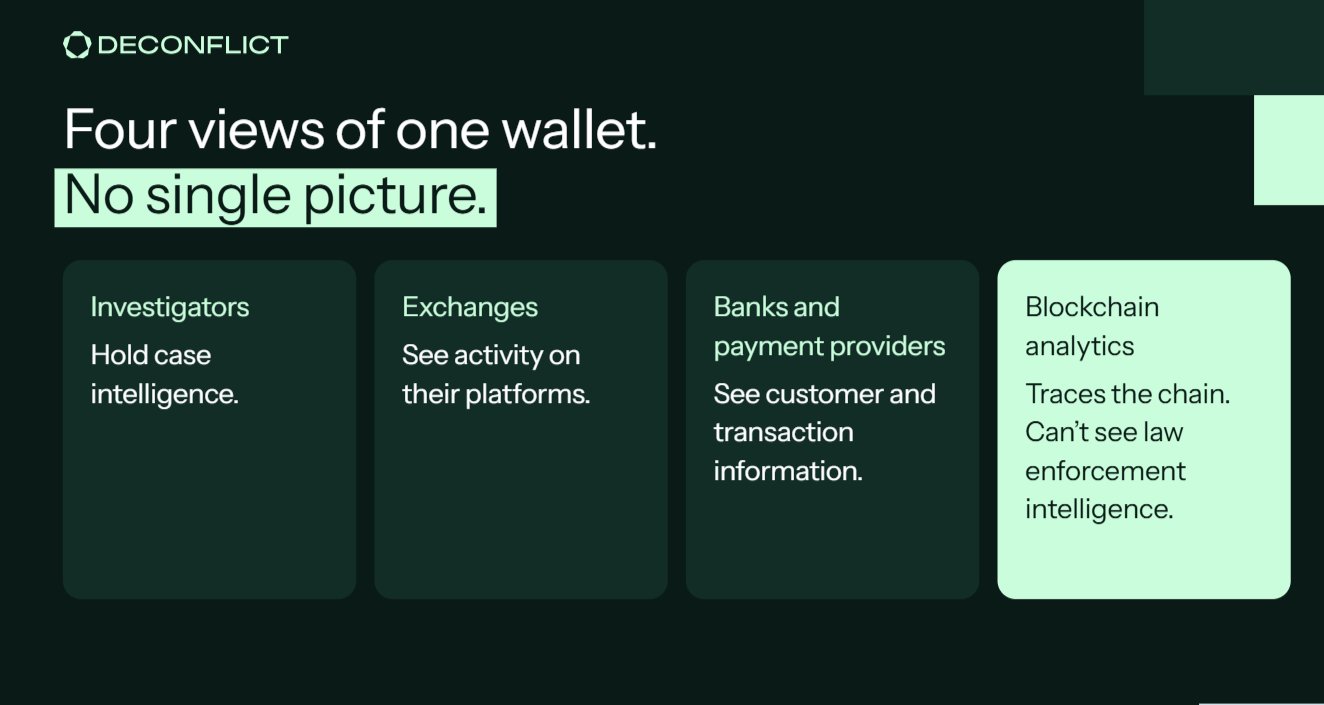
Each participant has a distinct view. Investigators may hold case intelligence; exchanges see activity on their platforms; banks and payment providers see customer and transaction information. Blockchain analytics can help trace on-chain activity but it does not independently show whether a law-enforcement agency has relevant intelligence about a wallet. These sources answer different questions, so the challenge is to connect relevant context without treating one signal as a complete conclusion.
Without a reliable way to surface overlap, teams may duplicate research, miss a chance to contact an investigator or make decisions without relevant context. Coordination can help close that gap while preserving each organization’s responsibility for its own investigation, legal obligations and decisions.
A deconfliction workflow can be understood in four steps:

A match is a prompt for evaluation, not a finding of guilt. It signals potential investigative overlap; people still have to assess the information, determine whether coordination is warranted and decide what action is appropriate.

Investigators should treat a match as a lead to assess, not an instruction to disclose case information. First, verify the identity and role of the counterpart through an approved channel. Then determine whether coordination could affect investigative timing, evidence handling, jurisdiction or operational security.
Before sharing information, decide what the other party needs to know to advance a legitimate purpose. A narrow exchange may establish that agencies are examining the same wallet and identify a point of contact without sharing the underlying case file. Record the purpose, participants, scope and outcome of any coordination. If a formal request for records or other legal process is required, follow the applicable process rather than treating a deconfliction match as authorization.
This discipline protects the investigation and makes the handoff useful. It also helps avoid a common mistake: interpreting a wallet connection as proof of who controls the wallet or what a transaction means. Investigators must assess attribution and supporting evidence in context.
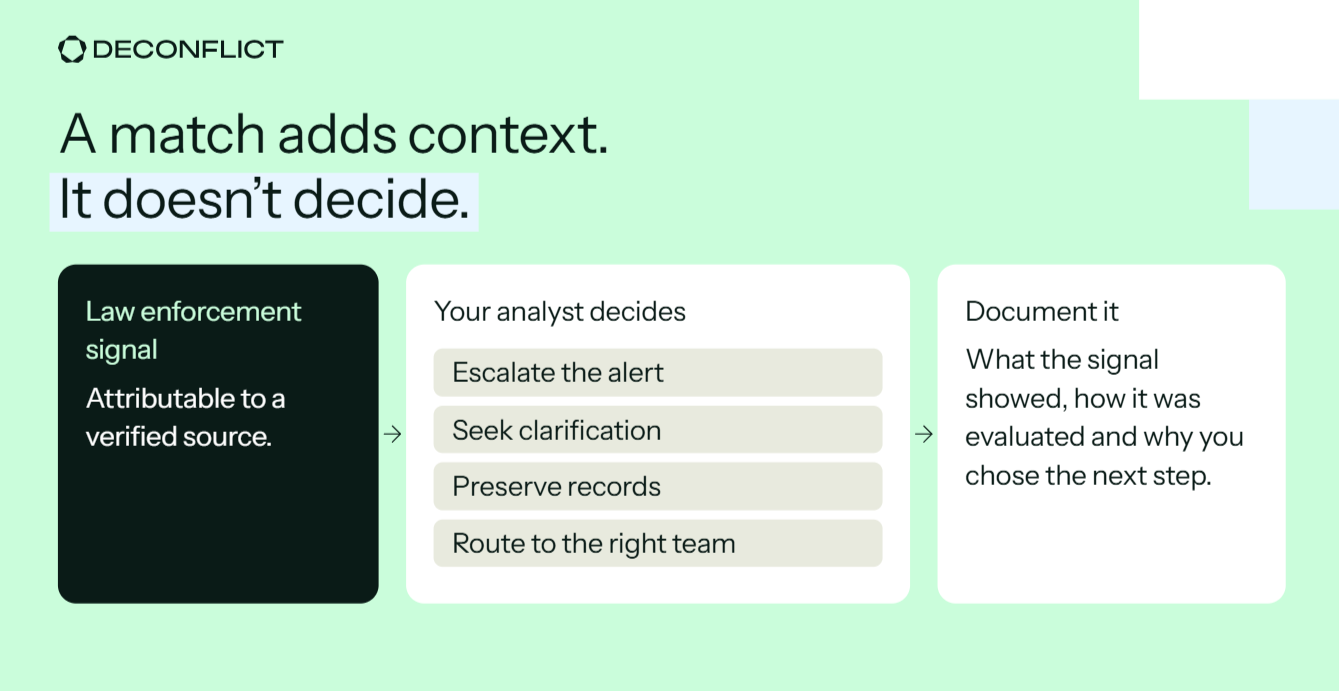
For banks, exchanges, fintechs and payment providers, a law-enforcement signal can add context to an existing review. It can help an analyst decide whether to escalate an alert, seek clarification, preserve relevant records or route a request to the appropriate team. Deconflict presents Signal as complementary to transaction monitoring, blockchain analytics, fraud detection, sanctions screening, onboarding and case-management systems.
Institutions should apply their established policies before taking action. A match does not replace a risk assessment, create legal authority to disclose customer data or dictate whether to restrict an account or transaction. Analysts should document what the signal showed, how they evaluated it, what additional information they considered and why they chose a particular next step.
Where follow-up with law enforcement is appropriate, secure coordination can help the institution clarify the context and route formal requests. For financial institutions, the value is not simply receiving another alert. It is knowing that a relevant, attributable source may have information and having a controlled way to evaluate whether further contact is warranted.
Deconflict connects participating law-enforcement agencies and regulated financial institutions through intelligence and coordination tools. The network includes more than 2,000 law-enforcement agencies, with participants in 50 countries.
Signal surfaces relevant law-enforcement intelligence in existing compliance workflows, including transaction review, wallet screening and case management. It complements blockchain analytics by helping answer a different question: whether relevant law-enforcement intelligence exists about a wallet or counterparty. Signal does not score or rank risk; analysts evaluate the information alongside other findings.

Nexus supports secure, attributable communication between verified investigators and financial-institution professionals when further coordination is appropriate. Deconflict also offers investigative tools such as Investigative Agent, which organizes on-chain findings, available attribution context and relevant Deconflict intelligence into a brief for human review. Its OSINT Agent organizes public-source findings around identifiers such as wallet addresses, emails, phone numbers, usernames, domains and IP addresses.
Deconflict also offers training and investigative resources, including subpoena templates, a VASP directory, an OSINT library and crypto investigation courses. Together, these capabilities support several stages of the work: finding investigative overlap, evaluating available context, coordinating with verified counterparts and organizing investigative leads.
Crypto deconfliction helps organizations discover when they may be working on the same digital-asset activity, while keeping the initial exchange narrow and controlled. Its value depends on more than identifying a match: participants need reliable attribution, defined disclosure limits, a documented communication path and human judgment at every decision point.
For investigators and financial institutions, the practical question is not only, “What does this wallet’s activity look like?” It is also, “Who else may hold relevant intelligence and can we coordinate responsibly?” Deconflict is designed to help answer that question without replacing existing controls, investigative judgment or legal process.
Learn how Deconflict supports crypto investigations and financial-crime coordination. Explore the platform or request a conversation with the team at Deconflict.com.
No. A match indicates potential investigative overlap for participants to evaluate. It is not proof of criminal activity, wallet ownership or guilt.
No. Blockchain analytics examines on-chain activity and behavioral risk. Deconfliction can surface relevant law-enforcement intelligence and potential investigative overlap. The tools provide different kinds of context.
Participating agencies contribute wallet addresses and darknet monikers, without case details, personal information or investigative narratives. Further disclosure is controlled by participants.
When a verified match requires follow-up, participants can use Nexus to coordinate securely and keep the exchange attributable and auditable.