
Register
Sign in
Menu
When Deconflict started, the problem was raw and immediate.
Mudassar Malik, our CEO and co-founder saw it firsthand during his 22 years with law enforcement: different teams were holding different pieces of the exact same crypto activity, but had zero clean, secure ways to know it.
An investigator could spend six months working a wallet address, completely unaware that a federal agency down the street was building a case on the exact same person. On the private side, a bank or crypto exchange might flag a suspicious counterparty, with no way of knowing that law enforcement already had an active warrant out for them.
Everyone had a piece. Nobody had the full picture.
So, we built Deconflict to fix that.
Since those early days, our network has quietly grown to over 2,000 law enforcement agencies across 40 countries. Investigators use Deconflict to surface overlap in active cases. Financial institutions use Signal to check if verified law enforcement intelligence exists on a counterparty. When a conversation actually needs to happen, Nexus gives authorized teams a secure channel to talk.
The work expanded rapidly. However, internally we realized something: our brand identity was lagging behind the reality of what we’d built.
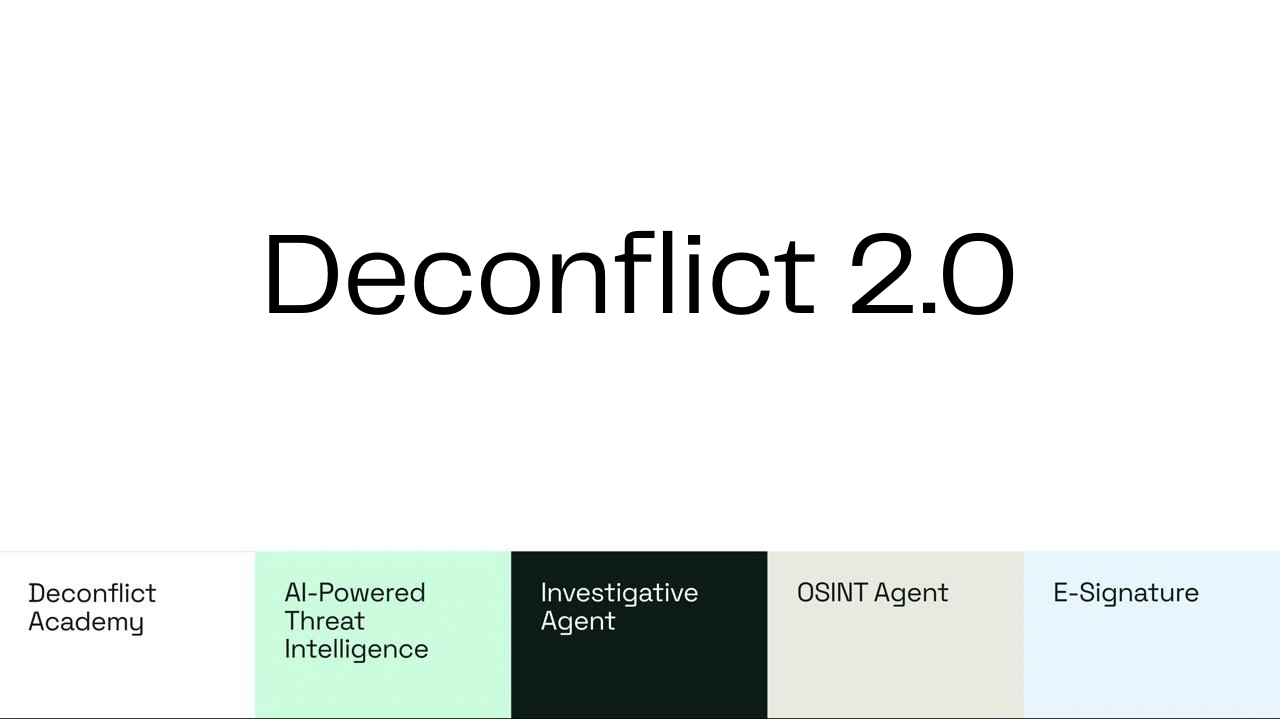
Today, we’re introducing a fresh brand mark, a new identity, new colors and five new products.
Our new tagline sums up the job we do every day: Ambiguity becomes clarity.
Here is the story behind why we refreshed our brand, how we approached it and where we’re going next.
A financial institution can invest millions in transaction monitoring, sanctions screening, fraud detection engines and blockchain analytics.
Those tools are great at surfacing risk. What they can’t tell you is whether a law enforcement agency already has verified intelligence on the exact counterparty you’re looking at.
That distinction is everything.
Meanwhile, investigators on the ground are working with intelligence that private institutions simply can't see. The result? Teams on both sides end up spending hundreds of hours independently reconstructing the exact same activity from opposite sides of the wall.
Deconflict doesn't replace the stack you already use. It gives those teams a way to see when their work overlaps, without exposing raw case files, sharing private data or violating compliance boundaries.
As we grew, we realized our messaging needed to be radically honest about our boundaries. Trust in this industry is built on precision, not feature inflation.
To be clear about our place in the ecosystem:
Our platform does not replace case management software, transaction monitoring engines, or institutional judgment. Those systems serve vital functions.
Signal serves a fundamentally different purpose: bringing verified law enforcement intelligence directly into the operational workflows financial institutions already run. It helps answer the single, crucial question that enterprise systems can’t: Is someone else already working this subject?
Our initial brand identity was crafted almost exclusively for detectives. That focus made sense at the time, because the first person who needed Deconflict was usually an investigator staring at an isolated wallet address, trying to determine where to begin a case.
That investigator remains central to everything we build. However, our network now encompasses compliance officers, fraud analysts, legal counsels, and risk leaders across global financial institutions.
The operational workflow has two distinct entry points that feed into the exact same network:
Different starting points, but the same underlying network. Our updated brand identity had to serve both sides seamlessly.
We didn't design a new logo simply to refresh our aesthetic. We wanted a mark that visually represented the actual mechanics of our platform.
For law enforcement, we chose the pentagon. It is structured, closed, and easily recognizable, representing a case with defined boundaries: a subject, a set of established facts, and a legal decision.
The broader financial ecosystem, by contrast, is a fluid, constantly shifting landscape made up of banks, crypto exchanges, payment processors, card networks, and self-custody wallets. Its edges are nearly impossible to draw neatly. We represented this environment with a softer, fluid outer shape.
.png)
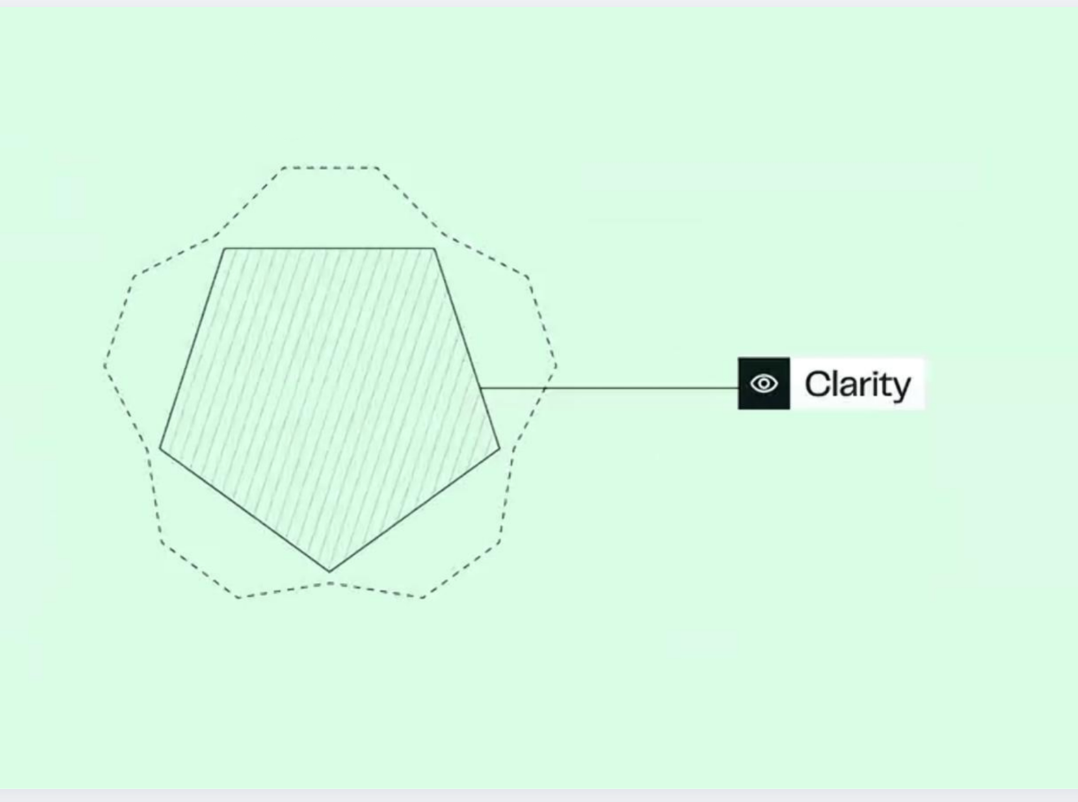
Our new mark places the defined pentagon right inside that fluid form. That visual intersection represents the exact moment Deconflict exists for: a financial institution is evaluating noisy, unresolved activity, while law enforcement holds a defined subject. When those two perspectives align within the same frame, ambiguity becomes clarity. The outer shape represents what hasn't been resolved yet; the inner shape represents actionable intelligence.
Our color palette follows the exact same philosophy:
Dark base tones give the entire identity weight, while clean beige and white spaces leave room for focus. The Deconflict identity sits precisely where green and blue meet.
We rebuilt our website from the ground up to feel less like a traditional software vendor pitch and more like essential industry infrastructure. The site plainly outlines our technical boundaries upfront: we match cryptographic identifiers rather than raw case files, and no data ever leaves an institution unless an authorized team explicitly chooses to release it. On a network handling sensitive intelligence, transparency is the ultimate foundation of trust.
Alongside our visual refresh, we’re proud to launch Deconflict Academy, a completely free training platform built specifically for detectives, analysts, and financial crime specialists.
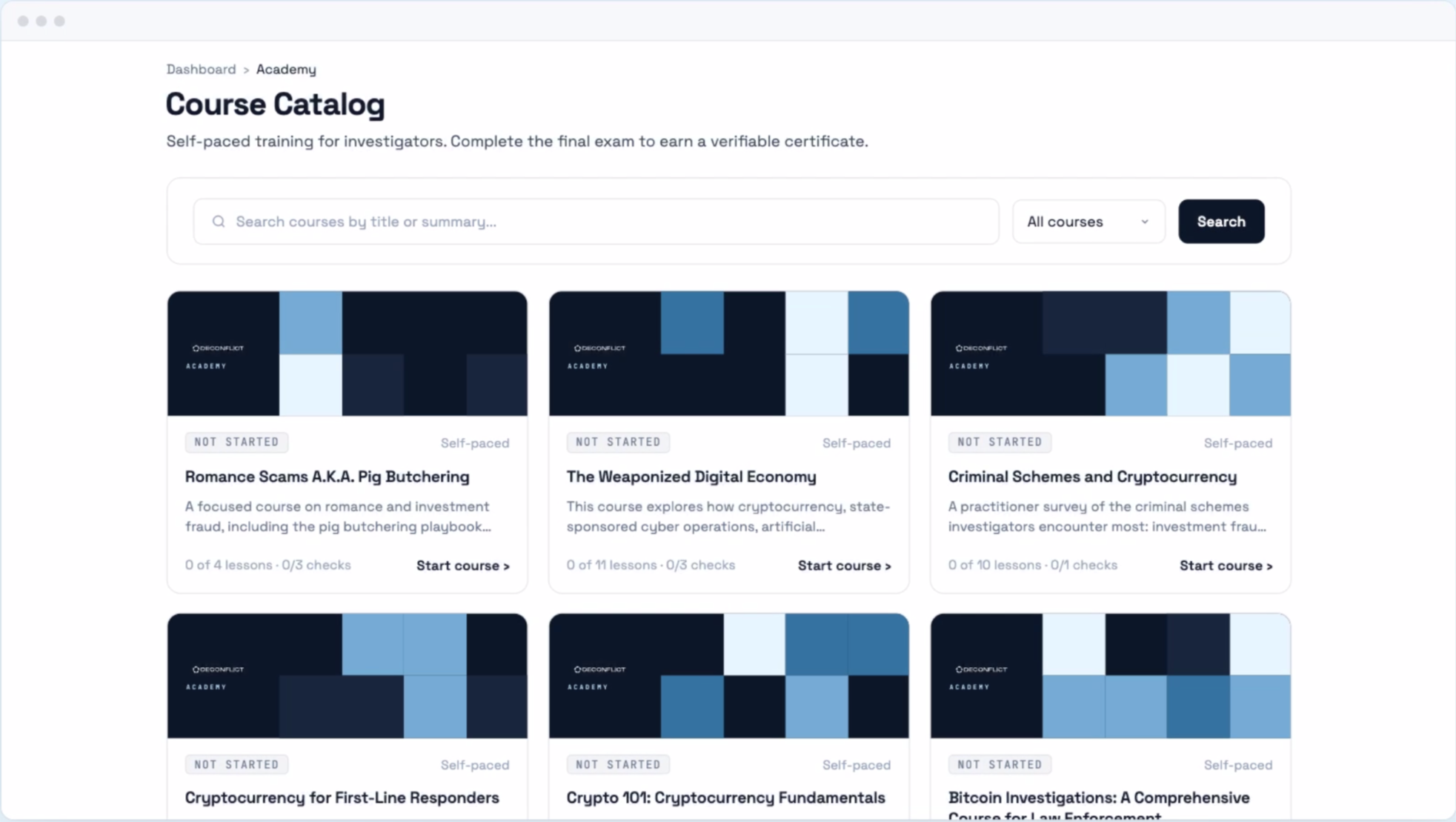
Connecting teams on a network is only half the battle. If an investigator lacks the technical skills to trace a multi-chain transaction or navigate a darknet vendor case, the network loses potential impact.
Authored by law enforcement veterans with hands-on experience at agencies like the DHS and DOJ, Academy delivers practical, self-paced courses covering:
We made Deconflict Academy a central pillar of our brand launch because education and coordination are deeply intertwined. A stronger, more capable network depends directly on the skills of the people using it.
At its foundation, Deconflict’s core mission hasn't shifted. The platform does what it has always done: illuminate operational overlap so teams can stop working in silos and start dismantling organized financial crime together.
Verified law enforcement agencies retain complete, free access to the platform. Financial institutions can integrate Signal to surface active law enforcement intelligence during counterparty risk reviews. Nexus remains ready whenever authorized teams need to communicate securely across jurisdictions.
Our name still carries the exact same instruction it always has: Check who else is on the subject.
Our brand identity has simply caught up to the platform we’ve built.
Deconflict refreshed its brand to reflect how the platform has grown. What began as a way for investigators to identify overlap in crypto cases now supports more than 2,000 law-enforcement agencies across 40 countries, alongside compliance, fraud, legal and risk teams at financial institutions.
It describes the moment Deconflict is built for. A financial institution may be reviewing unclear activity while law enforcement holds relevant intelligence on the same subject. When those perspectives connect through the right safeguards, teams gain clearer context for their next step.
No. Deconflict does not replace blockchain analytics, transaction monitoring, case-management software or institutional judgment. It helps authorized users identify potential overlap around relevant identifiers and coordinate securely when needed.
Signal helps financial institutions check whether verified law-enforcement intelligence exists on a counterparty during their existing review workflows. Nexus gives authorized teams a secure channel to communicate when follow-up coordination is appropriate.
Deconflict Academy is a free training platform for law-enforcement investigators, analysts and financial-crime professionals. It offers practical, self-paced courses created by law-enforcement veterans, with topics including wallet tracing, crypto fraud, sanctions evasion, darknet investigations and cross-border casework.