
Register
Sign in
Menu
A wallet can look risky, a payment can look suspicious and a domain can appear connected to a scam. Those are important signs, but they do not answer the question that can change how a financial-crime team responds:
Does this identifier have verified law enforcement relevance?
Crypto fraud moves through too many systems for any one organization to see the full story. A bank may see a customer payment. A crypto company may see the receiving wallet. A cyber team may identify the phishing site that started the scam. Law enforcement may already hold information that puts those details in context.
All-source investigations help bring those pieces together. They help teams develop leads, test assumptions and decide what deserves closer attention. Yet even a strong set of data points does not automatically show whether a wallet, account, identity or domain is relevant to a verified law enforcement matter.
That is the gap Deconflict is built to address.
All-source investigations bring together relevant data from multiple sources to develop, test, and refine an understanding of a potential threat.
The keyword here is relevant.
An all-source investigation is not an exercise in collecting every available record. More data does not automatically create more clarity. Effective investigations use the sources that can help explain a specific subject, event, transaction, account, identity, domain, or suspected fraud scheme.
In crypto-enabled fraud, those sources may include:
Each source can add context. None should be treated as conclusive on its own.
A wallet may be associated with suspicious activity. A customer may send funds after visiting a fraudulent investment site. A domain may resemble known scam infrastructure. Those signals may justify further review, but they do not automatically establish identity, intent, or investigative significance.
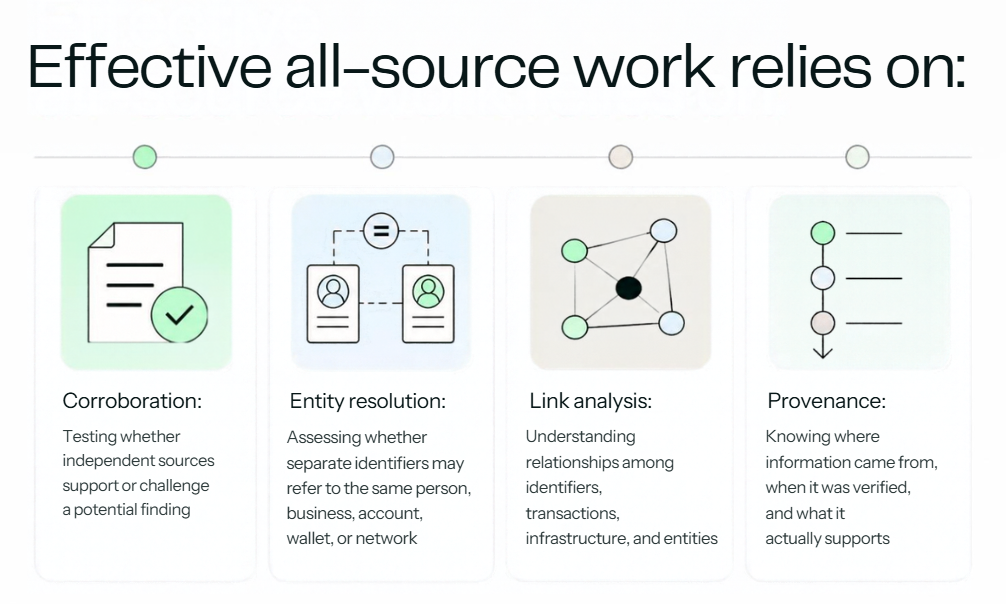
All-source investigations are a method for building context. They are not a substitute for investigative judgment.
Most crypto fraud begins long before a wallet appears in a transaction-monitoring queue.
A victim may be approached through a fake investment ad, a social-media message, a phishing email or a website impersonating a legitimate business. They may be persuaded to send money from their bank account to a crypto platform, then asked to move funds to one or more wallets. By the time a team sees the transaction, the scheme may have already touched several organizations.
Each organization sees a different part of the same event.
The bank sees the outgoing payment. The crypto company sees the wallet activity. A cyber team may see the fraudulent domain. An investigator may be working a related victim report, a suspect or a wider fraud network.
The problem is that these details do not automatically arrive in the same place.
A bank may know that a customer sent money to a crypto platform but not know whether that customer is a victim. A crypto company may see activity that deserves review but not know that the wallet is relevant to a current law enforcement matter. A cyber team may identify the infrastructure behind a scam but have no visibility into the payments moving through it.
Fraudsters benefit from this separation. They spread activity across accounts, services, wallets, identities and jurisdictions so that each team sees only part of the picture.
More data can help but what teams also need is the context to know whether the identifier in front of them is already relevant to verified law enforcement intelligence.
All-source intelligence is excellent at turning scattered information into a lead worth pursuing. It can bring together payment activity, public records, cyber indicators, identity details and wallet data, helping analysts spot patterns they would otherwise miss.
That is how many good investigations begin. It is not, however, the same as knowing what the activity means.
A wallet may have indirect exposure to suspicious activity. A customer may have visited a questionable website before sending money to a crypto platform. A domain may look similar to known scam infrastructure, or an account may share a phone number with another record.
Each detail deserves attention. None of them, on its own, confirms that the identifier is tied to a law enforcement matter.
This distinction matters when teams are deciding what to do next.
Deconflict provides Verified Intelligence for Financial Crime. It helps authorized financial institutions understand whether an identifier under review has verified law enforcement relevance, giving them context their existing data sources cannot provide.
This is not a risk score. It is not a generic data match. And it is not a replacement for an institution’s own investigative judgment.
It is verified investigative context delivered when it matters.
When cryptocurrency activity is relevant, institutions may use their existing tools to review activity associated with a wallet, transaction, counterparty, or on-chain relationship.
That context can help an analyst develop leads and determine whether activity warrants closer review. It may show relevant transaction history, counterparties, or possible relationships involving digital assets.
But wallet or transaction data does not necessarily establish who controls an address, why a transaction occurred, or whether an identifier is relevant to a law enforcement matter.
Deconflict does not provide blockchain analytics or transaction tracing. It provides Verified Intelligence for Financial Crime: verified law enforcement context that helps authorized financial institutions understand whether an identifier has verified law enforcement relevance.
Deconflict helps financial institutions and law enforcement agencies apply all-source investigative principles to crypto-enabled fraud by providing verified investigative context where existing systems identify risk.
Deconflict is not designed to broadly pool or expose customer, case, or investigative records. Instead, it provides verified law enforcement context and enables controlled coordination when an authorized counterpart is relevant.
When an institution needs to assess whether an ambiguous signal is relevant to a law enforcement matter, Deconflict provides verified context to support that assessment.
Signal delivers Verified Intelligence into the workflows where financial crime teams review wallets, counterparties, alerts, and cases.
When an authorized analyst is assessing a relevant identifier, Signal can help determine whether it has verified law enforcement relevance.
For example, a financial institution may be reviewing a customer transaction involving a crypto wallet. Internal systems may identify unusual activity, while existing wallet-analysis tools may provide transaction context. Signal can add verified law enforcement intelligence to help the analyst assess whether the identifier has verified law enforcement relevance.
The institution still evaluates the facts and makes its own decision. Signal provides stronger context at the point where that decision is being made.
Threat Intelligence helps authorized teams search, organize, connect, and summarize Verified Intelligence related to financial crime.
Crypto fraud investigations often begin with one identifier and expand from there. A wallet may lead to a domain. A domain may lead to an impersonation campaign. An account may relate to another account, business, contact detail, or fraud indicator.
Threat Intelligence helps teams explore those possible connections using verified investigative context. It complements existing fraud, AML, sanctions, wallet-analysis, and case-management capabilities.
When coordination is appropriate, Nexus provides a secure and auditable environment for verified law enforcement agencies and regulated financial institutions to communicate.
The model begins with overlap before content.
A participant can identify that an authorized counterpart holds the same relevant identifier without automatically receiving underlying case details, customer records, or sensitive investigative information.
If direct coordination is appropriate, each organization controls what it shares, with whom, and for how long. This allows participants to communicate around relevant matters without broadly pooling sensitive customer, case, or investigative data.
More information is not necessarily better information.
A fraud analyst needs to know the source of an intelligence item, when it was verified, what it supports, and what limitations apply. That is provenance.
Provenance helps teams distinguish between:
Deconflict preserves source attribution and verification date with the intelligence available through the network. This gives financial institutions better context for evaluating intelligence and maintaining a defensible record of why an alert was reviewed, a case was escalated, or coordination with law enforcement was considered.
Controlled sharing matters for the same reason.
Financial institutions must protect customer information and meet their legal and regulatory responsibilities. Law enforcement agencies must protect investigations, victims, sources, and sensitive case details.
Effective collaboration should not require indiscriminate data pooling. It should identify relevant overlap, verify the counterpart, limit disclosure to what is appropriate, and provide a documented record of the exchange.
Crypto fraud networks move across financial institutions, payment systems, crypto services, wallets, identities, domains, and jurisdictions.
All-source investigations help teams bring together relevant financial intelligence, open-source intelligence, cyber threat intelligence, identity information, digital-asset context, and investigative inputs. They help institutions identify patterns and develop leads.
But collection and correlation alone do not establish whether an identifier has verified law enforcement relevance.
Financial institutions do not need another source of unverified signals.
They need to understand whether a signal is relevant to a law enforcement matter.
Deconflict provides Verified Intelligence for Financial Crime. We help financial institutions and law enforcement agencies turn fragmented signals into clarity, investigate crypto financial fraud with stronger context, and coordinate when it matters.
An all-source investigation brings together relevant information from several sources to assess a potential threat. In crypto-enable fraud, this can include financial activity, public-source information, cyber indicators, identity details, digital-asset context and verified law enforcement intelligence.
The information depends on the case. Teams may review payment records, customer due diligence, wallet activity, websites, social-media accounts, domains, phishing indicators, public records and identity information. Each source can provide context, but none is automatically conclusive.
No. Deconflict does not provide blockchain analytics, wallet clustering, transaction tracing or risk scoring. It provides Verified Intelligence for Financial Crime, helping authorized teams understand whether an identifier has verified law enforcement relevance.
Deconflict adds verified law enforcement context to the identifiers institutions already review. Signal supports alert and counterparty reviews, AI-Powered Threat Intelligence helps teams organize relevant context around a lead and Nexus enables secure communication with verified law enforcement participants when appropriate.
A suspicious transaction or wallet relationship may warrant review, but it does not always show whether the identifier is tied to a law enforcement matter. Verified context helps teams better understand the significance of a lead while preserving their own investigative judgment.